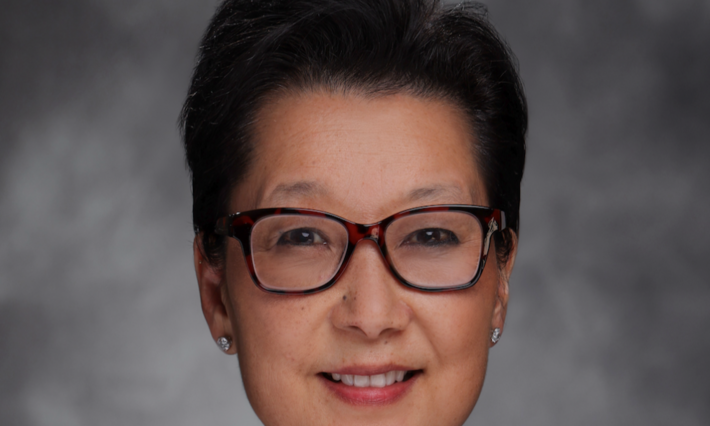
Katrina Cooke and her sons, Logan and Camden, at her 140th infusion treatment.
Counting on a Cure
Published
From the Duke Cancer Institute archives. Content may be out of date.
After a diagnosis in 2011 of metastatic breast cancer—cancer that has spread beyond the breast and to distant organs—Katrina Cooke has already had many more years with her two sons—now 12 and 14—than she ever thought possible.
When she was diagnosed, the statistics she read told her that most people with her diagnosis live only an additional year or two. But a combination of treatments, including surgery, targeted treatments like herceptin, and anti-estrogen therapies, worked for her. In December 2012, she was declared to have “no evidence of disease.”
While experiencing many ups and downs since then, she has used that “extra time” to become a professional speaker, peer mentor, and advocate. She became a peer mentor with the American Cancer Society and in 2017 joined the Duke Cancer Institute Oncology Patient Advisory Council (OPAC), a volunteer program that gives Duke cancer patients and their caregivers an opportunity to provide their perspective on the patient experience and offer recommendations on how to enhance it. Since 2018, she’s served as community co-chair of the group.
In June of 2020, a spot was found on her rib. Bone can be tricky to biopsy, making bone metastasis difficult to confirm.
She is working with Duke interventional radiologist Alan Sag, MD, and medical oncologist Kelly Marcom, MD, on further diagnosis and treatment.

"
We have to do what it takes to save my life. My boys need their mom.
"
Katrina Cooke
/
Patient
“Research is the only thing that will keep me alive,” says Cooke. “Eventually, I will run out of options and that will be it. We have to do what it takes to save my life. My boys need their mom.”
This article appears in the Winter 2021 issue of Breakthroughs magazine, which is produced twice yearly by Duke Cancer Institute Office of Development.
Multiple myeloma remains one of the most challenging hematologic malignancies to treat. Despite advances in therapy, many patients eventually relapse or develop resistance to standard treatments.A team led by Mikhail Nikiforov, PhD, professor in the Duke University School of Medicine Department of Pathology and Biomedical Engineering, and Duke Cancer Institute member, is uncovering a promising new approach that could reshape the therapeutic landscape.Multiple myeloma is characterized by uncontrolled proliferation of plasma cells, which produce large amounts of dysfunctional antibodies. These abnormal proteins can damage organs such as the kidneys and weaken bones, leading to pain and fractures.The disease environment in the bone marrow is rich in iron, a nutrient essential for cell growth and DNA synthesis. Cancer cells exploit this iron abundance to fuel their rapid proliferation.However, excess iron can also trigger a unique form of cell death called ferroptosis, driven by oxidative damage to cell membranes.“Ferroptosis is a programmed death caused by iron-dependent lipid peroxidation, and it’s particularly relevant in iron-loaded environments like the bone marrow,” Nikiforov said.Nikiforov’s team focused on why some myeloma cells resist ferroptosis. Using genetic screening, they identified a kinase called STK17B as a key player. High levels of STK17B not only suppress ferroptosis but also correlate with poor patient survival and resistance to bortezomib, a cornerstone drug in myeloma therapy.“This kinase appears to help cancer cells maintain iron balance and avoid ferroptotic death,” Nikiforov said. “When we inhibit STK17B, iron overload tips the scale, and the cells die.”The team collaborated with Timothy Willson, PhD, Harold Kohn distinguished professor in open science drug discovery at the University of North Carolina Eshelman School of Pharmacy, who had previously developed an STK17B inhibitor. Using an improved formulation, they tested the compound in two myeloma models and observed significant efficacy.The findings were strong enough to warrant a provisional patent and open the door for future drug development. Currently, no FDA-approved therapies specifically induce ferroptosis.“Our work suggests a new therapeutic angle—targeting iron addiction in cancer cells,” Nikiforov said. “It could complement existing treatments and potentially apply to other iron-rich tumors.”Future research will explore combination strategies with standard therapies and immune-based approaches, as well as whether ferroptosis-targeting drugs could benefit other cancer treatments. The team is also investigating what regulates STK17B activity, aiming to uncover additional intervention points.“We’re excited about the possibilities,” Nikiforov said. “It’s early, but the data are compelling.”